

Jerry, is a disability justice leader and activist from Kenya. He is also part of the 2025 cohort of the Global Disability Leadership Academy. Jerry is the founder of Missing Voices, an initiative that uses storytelling as a form of justice to amplify the voices of persons with disabilities having intersecting identities of gender, sexual orientation and identity.
Jerry shares about his advocacy work, storytelling approach and his journey towards disability inclusion and leadership.
About the Global Disability Leadership Academy.
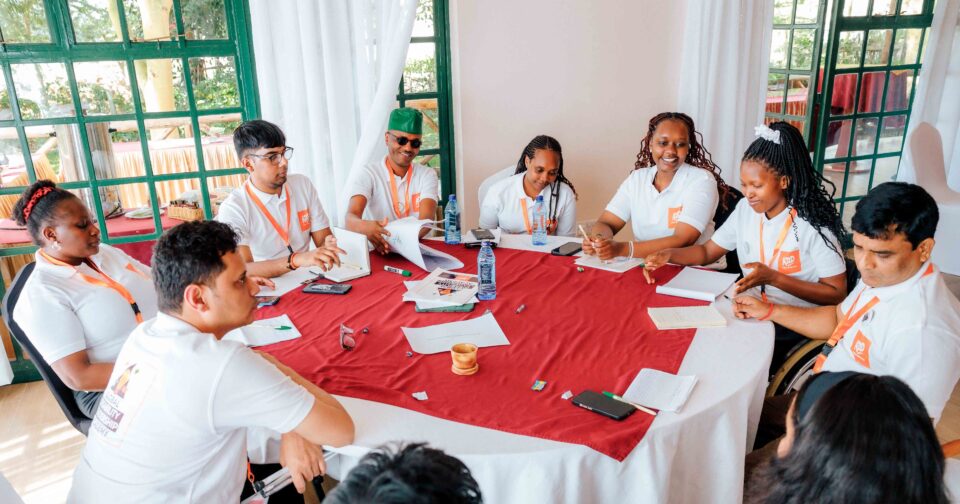
In April 2025 we launched the Global Disability Leadership Academy through a pilot in Nairobi, Kenya.
The Academy exists to support the unique but largely untapped leadership potential of disability justice leaders – especially young people and women with disabilities. Many of these groups have received little or no support with their leadership journey. But their leadership would contribute to a diverse and thriving disability justice movement.
At the academy, disability justice leaders are equipped with knowledge and skills on leadership and advocacy. Jerry is using the knowledge and skills acquired from the academy to advocate and amplify voices of disabled persons with intersecting and marginalised identities.

“My journey with Missing Voices started 4 years ago when I shared about the realities of disabled persons with multiple intersecting identities of gender, sexual orientation and other marginalised identities. The conversations were new to a lot of people, and this was a reminder of the daily struggles of disabled persons which often are missing from conversations. This reality birthed my dream to create space for stories that are often erased, and now I do this through Missing Voices.”
Jerry Okiki, Disability Justice Leader, Kenya
Using Storytelling as a tool for justice.
During the time at the Global Leadership Academy, Jerry shares on how he worked on his personal initiative project to collect and share stories of persons with disabilities having intersecting identities of gender, sexual orientation and identity across his community.
“We used storytelling, workshops, and advocacy spaces to hold conversations around identity, belonging, and discrimination. We held small, safe workshops where participants could share at their own pace. Some wrote, others spoke, some simply sat and listened. Every story mattered.”

Jerry wearing a stripped dark grey suit, sharing a reflection during Global Disability Leadership Academy In person meeting.
“The approach behind our advocacy and meetings approach is intentional and grounded in care. We shared and learned from each other and the participants had full control over what to share, what not to share, and how to be represented. That trust was everything.”
During one of our workshop meetings, one of the participants shared their reflection and said:
“After our first workshop meeting, I wrote about my life and story for the first time. I didn’t post it anywhere, but I kept reading it to myself. That’s when I realized my story matters, even if only to me.”
Learning and Impact.
“One of the big learnings I got during my project journey is that storytelling is not just about publication it’s about transformation. Some of the workshop participants and activists came in timid, uncertain, and left with their heads higher.
Others shared by saying, ‘I fully accept my story and identity as part of who I am.’ “That’s power.”
“During the next steps of Missing Voices, we expanded the workshops, bringing more queer disabled persons together to learn storytelling as a skill not just to share their own stories, but to lead the conversation for others. We built a stronger partnership with Equal Voices organization”

“One of the challenges many queer persons with disabilities face is lack of awareness and stigma from society. Many have experienced family rejection, violence, or exclusion from both disability and inequality circles. Even finding participants for our workshops was difficult; most have been forced to hide themselves.”
Jerry Okiki, Disability Justice Leader, Kenya
“What Missing Voices advocates for is rooted in Radical Inclusivity. We let queer persons with disabilities lead the narrative and tell their own stories and experiences in their own words. This is giving power to them and letting them decide on their own.”
Hopes for the future.
“My plan is to expand Missing Voices to reach queer disabled people in every community. Expanding workshops into rural areas is one vital area I want to see happen. I also see digital platforms as a way to make storytelling accessible to those who cannot attend in person.”
“I also plan to train the participants to grow into leaders. My plan is to create a Trainer of Trainees model, so they can facilitate workshops themselves. This way, the skills we share ripple outward. I also want to build mentorship networks that connect emerging voices with established queer disabled leaders.”
“Visibility matters deeply to me. I want stories of queer disabled people to be showcased through podcasts and films. These stories should not only be heard but also used as advocacy tools to influence cultural institutions and policymakers.”
“Partnerships will remain central. Working with other organisations to strengthen our foundation, and to deepen collaborations through joint campaigns.”
“Finally, my hope is to secure sustainability. That means funding to keep workshops free, and measuring our impact in confidence, visibility, and opportunity. In five years, I see Missing Voices as a hub of training, a cultural archive, and a movement shaping policy led by queer disabled voices themselves.”
Find out more

MEET THE 2025 GLOBAL DISABILITY Leadership ACADEMY FELLOWS.
Meet our first group of academy participants that participated in the pilot. They each share about their projects, what they are passionate about.
THE GLOBAL DISABILITY LEADERSHIP ACADEMY.
The Leadership Academy support the global network of disability justice activists across the world to become the next generation of change makers.