

A participatory fund for women with disabilities.
The Disability Justice Fund for Women is a fund designed by women with disabilities in Ghana, Uganda and Tanzania, to make sure it meets the real needs of disability justice activists in these countries.
Grants have been given out to grassroots organisations led by women with disabilities – a group that are often overlooked when it comes to funding. The money is being used by grantees in Ghana, Tanzania and Uganda to support their work advocating for justice and equality and supporting the African Disability Protocol – a framework for disability justice in Africa, as well as activities like income generation, making spaces more accessible, and strengthening disability justice movements to work together.
These are the grantees from Tanzania.
Agnes – What Girls Want.

Agnes is a person with hearing impairment and the project coordinator for What Girls Want. The organisation works with school teachers and district coordinators to support children with disabilities.
“What inspired us to create What Girls Want was to address the challenges girls with disabilities face in different sectors, for example in employment, sexual and reproductive health, and in school and university.”
“Before we couldn’t do this work because we didn’t have resources. But with this funding from ADD we can pay for things like transportation and access to reach the girls we want to support.”
“When I wanted to go to school, I wanted to take public transport, but because of my hearing impairment I couldn’t hear what the bus conductor was saying, which made it hard for me to go to school. There is also a challenge in the education system.”
“I want to change the system. We can use technology to support education, and people with hearing disability should also be allowed to learn vocational skills and do apprenticeships. It’s all about choice.”
“This project is going to help girls with disabilities to have the courage to speak for themselves, to stand up and say what they want to say. And this will benefit all of society.”
Josephine & Mary – Tanzania Albinism Society.

Josephine and Mary are from the Tanzania Albinism Society. They are the leaders of the group. The organisation advocates for the rights and justice for people with albinism, especially women and children. They also support disability issues more generally.
“We are happy because this new fund is going to help young women and girls with albinism. It will support them to fight for their rights, to know their rights and become changemakers, to advocate and speak for themselves.”
“Women with disability face double the challenges of other women. We should be aware of our rights, for example through the African Disability Protocol, but also what to do when injustice occurs. It’s about building up our power to speak for ourselves, being free and confident and having self-esteem and participating in social and political activities.”
“Choosing leaders who are women with disabilities brings a more positive outcome since we are directly involved and we have complete experience of what is happening in our society.”
Lupi – Tanzania Association of the Deaf (CHAVITA).

Lupi is part of the gender department of CHAVITA working with women and girls with disabilities. Using the grant received from ADD International, they have developed a small project focusing on women and girls with disabilities.
“Using our grant from ADD we have developed a small project focusing on women and girls with disabilities. We are providing training to these groups to help them access information. These groups face a lot of violence and discrimination, so we make sure that they know their rights and are supported to advocate for and enjoy their rights.”
“We want to create awareness in society about these rights. We want to come up with strategies that make sure the deaf community are involved in everything – for example issues of education and health. We want to meet local Government authority leaders and get them involved with the project because they know their people and their communities.”
“I want to see women with disabilities living a good life and being involved in everything and accessing everything they want. I would like to see members of parliament or even a president who is a woman with a disability.”
Sophia – Peace Life for Persons with Disabilities Foundation.

Sophia is a teacher by profession and is currently pursuing her Master’s in Education at the Open University.
“I’m a disabled person but I teach in mainstream school with people without a disability. I want my students to also be champions for disability. I want to learn more about them and they want to learn more about me.”
“The school environment is not very accessible. But things are improving. Many people are raising their voices about inclusivity, not just in Tanzania but around the world. Many parents have become more aware about the importance of education for children with disabilities.”
“We have so many policies for the Government to support people with disabilities, but you have to struggle much to get that support, even if it’s your right.”
“With this fund we want to do advocacy for women with disabilities. We want to do training on issues like gender-based violence and listen to people’s stories who have been affected by these issues.”
“I have lived experience of disability, so I know how to go about this work. When people see us, they believe in us. But the bigger organisations, they don’t believe them. They trust us because we are the ones wearing the shoes. We are coming up with solutions that work for us.”
“This fund is bringing power to people with disability so they can act for themselves, because most people don’t trust people with disabilities. We appreciate this work and we are making sure we are bringing impact.”
Elizabeth – MOWADITA (Movement for Women and Girls with Disabilities Tanzania).

The Movement for Women and Girls with Disabilities Tanzania is working to support women with disabilities economically with entrepreneurship.
“Many persons with disabilities face financial challenges, but if they have the skills and funds to start their own business, things will be better and they can earn a living.”
“Through this fund we plan to run a training on entrepreneurship skills and give them seed money to start their own businesses. Some of the business training involves creating liquid and bar soap, and body oils. We would also like to teach them how to make batik fabric.”
“In future I hope women with disabilities can live a free life without discrimination.”
“We know our own challenges as women and girls with disabilities. When we are led by other people who don’t have a disability, they can’t imagine what we are going through. So we are the ones who should take the lead.”
FIND OUT MORE
MEET THE DESIGN TEAM
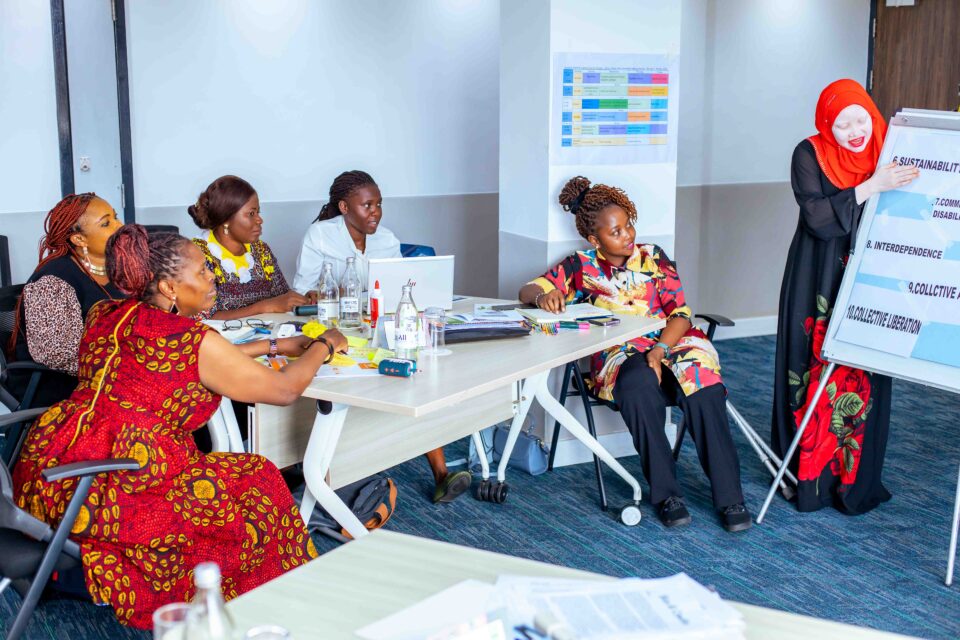
A group of women with disabilities from Ghana, Uganda and Tanzania worked together to decide how funding for women with disabilities should best be spent.

DISABILITY JUSTICE FUND FOR WOMEN
A participatory fund for women with disabilities. This fund has been designed by women with disabilities in Ghana, Uganda and Tanzania.

THE AFRICAN DISABILITY PROTOCOL
The African Disability Protocol (ADP) is the first human rights treaty addressing discrimination faced by people with disabilities in African countries.