
2025 Annual Report.
Welcome to our 2025 Annual Report. This was a year of putting our Mtiririko Strategy into practice — shifting resources, power and decision-making towards disability justice movements and activists while learning what it means for ADD International to work differently.
Photo: Juliana (Left) and Cebile (Right), Global Disability Leadership Academy Fellows.


A note from our Board Co-Chairs.
2025 was an important year for ADD International as we reflected on 40 years of working alongside disability movements and looked to the future.
Since 1985, activists and organisations have shaped our work and led change for disabled people. In 2025, we continued that journey by putting Mtiririko into practice — shifting power and resources closer to the people and movements driving change.
We supported participatory grant-making, explored new ways to fund grassroots organisations, and listened to activists about what fairer funding means.
There is still much to learn and change. But 2025 showed us what’s possible when we share power and make space for others to lead.
Our commitment is simple: listen, learn and work alongside disability justice movements.
With appreciation,
Liz and Vanthon
Co-Chairs, ADD International.

Liz Sayce and Vanthon Srey.

40 Years of Disability Justice.
2025 was a special year for ADD International as we celebrated 40 years of advancing disability justice. Since our beginnings in Zimbabwe, we have worked alongside disability justice activists and organisations across 17 countries in Africa and Asia, supporting more than 2,400 Organisations of Persons with Disabilities and Self Help Groups. Together, we have strengthened disability movements, challenged stigma and discrimination, and helped influence disability justice and inclusive policies.
Our 40th anniversary is a celebration of what can be achieved when people with disabilities are supported to lead, organise and drive change. It is also a reminder that the progress made over four decades cannot be taken for granted. With the continued solidarity of our supporters and partners, we remain committed to standing alongside disability movements around the world and building a future where everyone’s voice and dignity are recognised.
Aktar, a Disability justice activist from Bangladesh says;
“To all our supporters, I want you to know that your support truly matters – more than you may ever realise. Because of your solidarity, women like me – who once had no voice in society – are now leading, organising, and driving change in our communities. Your support doesn’t just fund programmes; it fuels hope, dignity, and real transformation.”

Aktar, Disability Justice Activist, Bangladesh.
The Disability Justice Fund for Women.
In 2025, women with disabilities from Ghana, Uganda and Tanzania came together to design the Disability Justice Fund for Women — deciding what the fund should support, how it should work and who should make funding decisions.
Drawing on their lived experience and knowledge of disability justice movements in their communities, the design team prioritised groups often least able to access funding, including marginalised women, women in rural areas, girls and older women. They worked to ensure the fund was accessible and responsive to their realities.
For the women involved, being at the centre of the design process was an important shift in power. As Beatrice, a disability justice activist from Ghana, reflected:
“It is very crucial to give power to women with disabilities to decide on their needs and practical ways of addressing them.”

Beatrice, Disability Justice Activist, Ghana.
Joy, a disability justice activist from Uganda, highlighted the value of designing the fund alongside peers:
“As a woman with a disability, it was the first of its kind of being part in design of the project… The guidelines formulated by the design team are inclusive and cater for all women with disabilities including the most excluded.”
The process put ‘nothing about us without us’ into action, giving women with disabilities the power to shape the fund based on their needs, experiences and priorities.
Background Image: Njahira, Design Team Member.
The Global Disability Leadership Academy.
In April 2025, we launched the Global Disability Leadership Academy (GDLA) through a pilot in Nairobi, Kenya, bringing together disability justice activists from Africa and Asia for a week of learning, collaboration and leadership development.
The Academy supports the leadership potential of disability justice leaders, particularly young people and women with disabilities, providing skills, mentorship and peer connections to help them turn their ideas into action.
Cebile, a 2025 fellow from Eswatini, is using her learning to advocate for greater disability inclusion in her community. She has established an online Disability Inclusion Talk Show, creating a space for people with disabilities, families and caregivers to share experiences and discuss challenges.
Her advocacy has already contributed to practical change. After a wheelchair user raised concerns about poor roads affecting their mobility, Cebile and others engaged local authorities. The roads were subsequently improved, making it easier for people with disabilities to access services and participate in community life.
“The skills and support I gained from the Leadership Academy have really been impactful because before I joined the academy, I only had the desire and lived experience to create change, but I lacked the knowledge and practical skills to advocate effectively.”
Cebile’s story demonstrates how investing in disability justice leadership can help turn lived experience into meaningful action and community-level change.
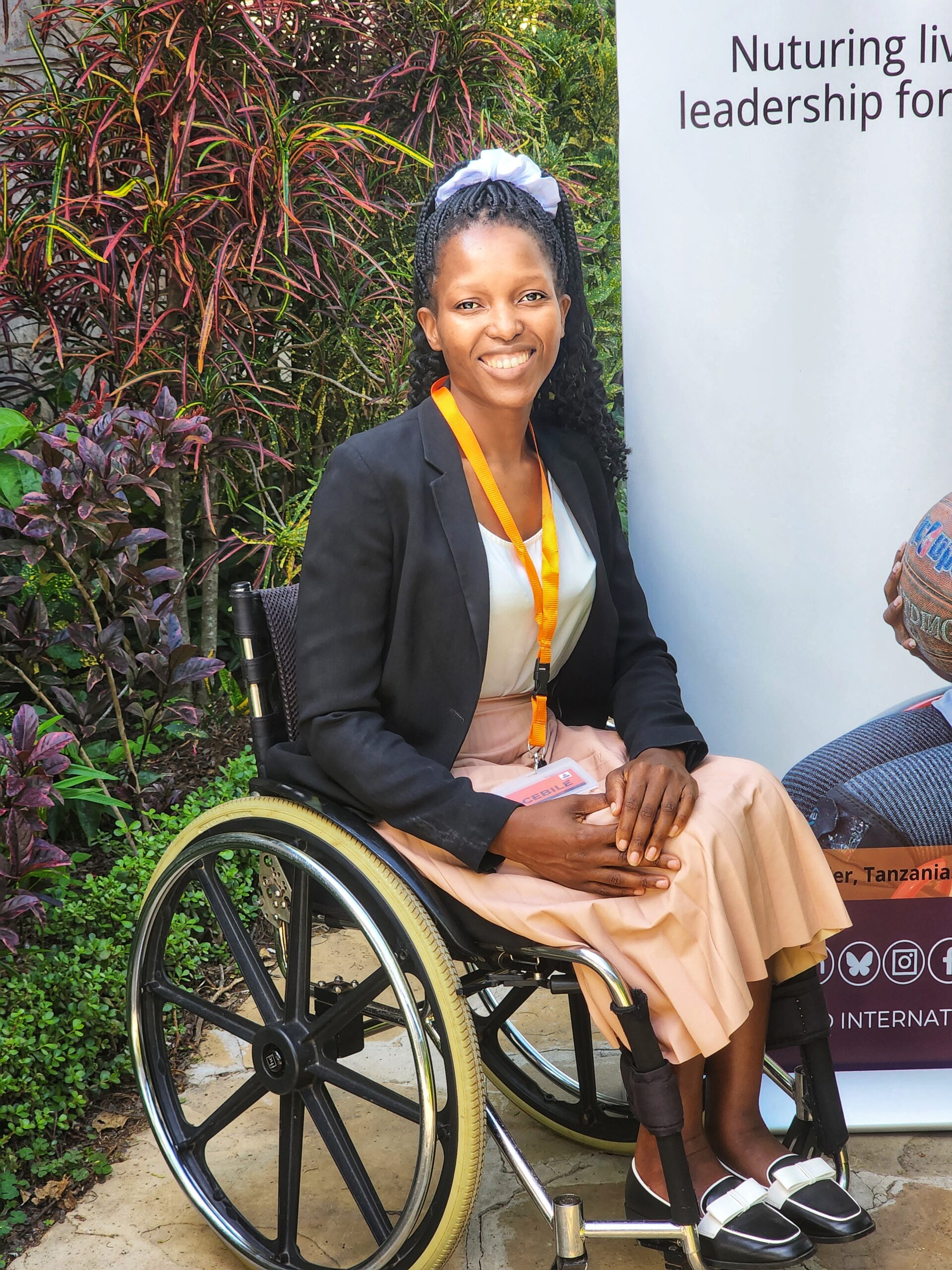
Cebile, Leadership Academy Fellow, Eswatini.
Background Image: Akash, Leadership Academy Fellow, Bangladesh.
Fairer Funding for Disability Justice.
In March 2025, the Fairer Funding webinar series was launched, bringing together disability justice activists and leaders of organisations of persons with disabilities (OPDs) to share their experiences of accessing funding and what needs to change.
OPDs and activists are leading change in their communities, yet they receive very little funding, which is often short-term, restricted and difficult to access.
As Ganesh, a disability justice activist from Guyana, explained:
“The biggest issue with most funding opportunities is that they come with strict and inflexible criteria. Many grants focus on general development projects without considering the unique needs of people with disabilities.”
The series called for more flexible, long-term and accessible funding, with OPDs having greater power to decide how resources are used. It also highlighted participatory grant-making as one way to shift power to disability justice activists and organisations, enabling them to set their own priorities and strengthen their movements.
Watch the campaign video series:

The Power of Community Appeal.
Through our appeal to support organisations across Asia and Africa to continue their vital work alongside and within their communities, we raised £11,160 to support disability justice.
Thank you to everyone who donated and helped us reach this amount. Your support helps organisations led by people with disabilities to continue their work, build sustainable livelihoods, challenge discrimination and create more inclusive communities.
One organisation benefiting from this support is BUDWA (Bwera United Women with Disabilities Association) in western Uganda. For more than 20 years, BUDWA has supported women and girls with disabilities to develop skills, earn an income and live free from discrimination and violence.
As BUDWA founder Juliet Mbambu says:
“If given the chance we are positive change makers. As women with disabilities we just want to reach our full potential.”

Juliet, Disability Justice Activist, Uganda.
Thank you for helping make this work possible.
What we are Learning from Doing Things Differently.
Changing how an organisation works takes time. Over the past five years, we have been learning what it means to do things differently. We have challenged how we work, how we use power, and how we share decisions with disability justice activists and partners.
Here are some of the key lessons from this journey.
- In 2025, we learned that shifting power is not simply about creating new funding programmes or changing decision-making processes. It requires changes in relationships, attitudes, systems and culture. Most importantly, we learned by listening to activists and partners.
- Before we could think about shifting power, we needed to consciously recognise the power we had and understand what constraints we faced as an organisation.
- To do all this, we had to be as clear about what we were going to stop doing as about what we would start.
- Our team have had to learn new ways of doing their work where they let go of being an ‘expert’ and let activists decide.
- Our transformation journey has been more about using our power intentionally and working out what power we can share and shift, how and to whom.
- We are continuing our transformation and will continue learning along the way.


Alan (Left), Disability Justice Activist Kenya, and Cebile (Right), Leadership Academy Fellow, Eswatini.
2025 Impact at a Glance.
2025 was a year of putting power into practice. These numbers show some of the people, organisations and communities reached through our work.
- 2025 was a year of putting power into practice. These numbers show some of the people, organisations and communities reached through our work.
- 6 Countries across our participatory grant-making funds
- 66 Disability-led and grassroots organisations supported
- £403K Transferred as grants for organisations to use on local priorities
- 1,000 Applications received to the Disability Justice Fund for Women
- 430 Cash grants distributed to disabled people affected by conflict in Sudan
- 51 Disability justice activists in Cambodia appointed as local gender-based violence focal points
- 2 Women with disabilities from the Tanzania fund panel became Members of Parliament
- Behind every number is a person, organisation or community working to create change.
- These figures show our reach in 2025, but they do not tell the whole story. The bigger change is in who gets to make decisions and set priorities.
Behind every number is a person, organisation or community working to create change.
These figures show our reach in 2025, but they do not tell the whole story. The bigger change is in who gets to make decisions and set priorities.
Acknowledgement of Support from players of Postcode Lottery.
We are delighted to receive a £500,000 award from Postcode Justice Trust thanks to funds raised by Postcode Lottery players in 2025.
These funds have supported our work in Uganda, Tanzania, Sudan, Bangladesh, Cambodia, and Ghana to resource disabled people’s activism and nurture their leadership.
Importantly, the activists and organisations themselves are deciding how funding is used and leading the work that matters most to their communities. This puts decision-making in their hands and supports them to set priorities, shape solutions and lead change on their own terms.


Thank you to all our Supporters!
Thank you to our amazing supporters for supporting disability activists and their organisations to bring about vital social change. A special thank you in particular to:
- Atlantic Fellows for Social and Economic Equity LSE
- Comic Relief
- Dutch Ministry of Foreign Affairs
- EA Foundation
- Foreign, Commonwealth and Development Office
- Ford Foundation
- The Global Impact Fund for Women and Girls by Hauwa Ojeifo
- United Nations Trust Fund to End Violence against Women
- United Nations Women’s Fund
- Wellspring Philanthropic Trust
- See You Foundation
- Players of Postcode Lottery
New Developments.
Working differently: prioritising wellbeing and flexibility.
In 2025, ADD International trialled a Year of Working Well to strengthen wellbeing, flexibility and inclusion across the organisation. The trial introduced a four-day working week on full pay, wellbeing leave, improved global leave standards, a whole-organisation rest week and enhanced performance reviews.
We also strengthened our workplace accommodations policy and supported teams to work more effectively by reducing unnecessary meetings, prioritising high-impact work and protecting time away from work.
The results were overwhelmingly positive: 100% of staff said the trial had been positive for them and 97% reported improved wellbeing. We also saw reduced short-term sickness absence, increased holiday uptake and no increase in performance concerns.
“The four-day week has supported better work–life balance, wellbeing and productivity. It encourages more focused work and intentional planning, both individually and as a team.”
— ADD staff member
Most changes have now been adopted permanently. While we continue to refine our approach, the experience has shown that prioritising wellbeing can support both staff and organisational effectiveness.
We are sharing this in the hope that it contributes to wider conversations across the sector about what more inclusive, sustainable, and humane ways of working can look like in practice.
We are no longer posting on Twitter/X
We officially stopped posting and engaging on X (formerly Twitter), following changes to the platform’s leadership, policies, and overall direction. The decision reflects our commitment to disability justice principles, including accessibility, equity, and community care.
We have transitioned our social media engagement to Bluesky and continue to connect with our community through LinkedIn, Facebook, Instagram, our website, YouTube, and our newsletter. We thank everyone who supported and engaged with us on X and look forward to continuing these connections across platforms that better align with our values.

2025 Financial Overview
£3,278,294
TOTAL INCOME
£3,613,847
TOTAL EXPENDITURE
| Unrestricted funds £ | Restricted Funds £ | 2025 Total funds £ | 2024 Total funds £ | ||
|---|---|---|---|---|---|
| Income from | Grants, donations and legacies | 1,599,718 | 12,239 | 1,611,957 | 1,798,304 |
| Interest receivable | – | – | – | 4,333 | |
| Charitable activities | – | 1,657,047 | 1,657,047 | 1,681,714 | |
| Other income | 9,290 | – | 9,290 | 9,857 | |
| Total income | 1,609,008 | 1,669,286 | 3,278,294 | 3,494,208 | |
| Expenditure on | Raising funds | 471,310 | – | 471,310 | 400,962 |
| Support of the International Disability Movement | 1,230,309 | 1,912,228 | 3,142,537 | 2,301,956 | |
| Total expenditure | 1,701,619 | 1,912,228 | 3,613,847 | 2,702,918 | |
| Net income / (expenditure) | (92,611) | (242,942) | (335,553) | 791,290 | |
| Transfers between funds | 63,025 | (63,025) | – | – | |
| Net movement in funds | (29,586) | (305,967) | (335,553) | 791,290 | |
| Fund balances at 1 January | 917,332 | 595,897 | 1,513,229 | 721,939 | |
| Fund balances 31 December | 887,746 | 289,930 | 1,177,676 | 1,513,229 |
For our full audited 2025 accounts, please see: add.org.uk/annual-reports

The next chapter of supporting disability justice.
For 40 years, ADD has been supporting disability justice activists and their organisations to lead change.
The next chapter depends on continuing to support that leadership.
You can be part of it.
Your support can help disability justice activists and grassroots organisations organise, influence decisions, and create change in their communities.
Donate today and help put disability justice movements in control of their own resources.
Make your free Will with Farewill
We’re delighted to offer ADD supporters a free online Will through our partnership with Farewill.
Plan for the people and causes you care about, and help support disabled leaders to create change for generations to come.
Other ways to support disability justice.
Give monthly – Provide reliable, flexible funding where it’s needed most.
Take on a challenge – Walk, run, cycle or fundraise your own way.
Stay connected – Hear directly from disabled leaders through our newsletter.
Join the conversation – Follow us on social media and help share stories of disability justice.